

The latest changes to the SCHADS Award have created a lot of confusion for NDIS providers. This article helps providers understand and manage this change.
The challenge for providers
You must pay part time or casual workers a minimum of 2 hours pay for any shift – even if the shift is less than 2 hours long
Before 1 July 2022, there was no minimum hours for part time workers and casual workers had a minimum of 1 hour.
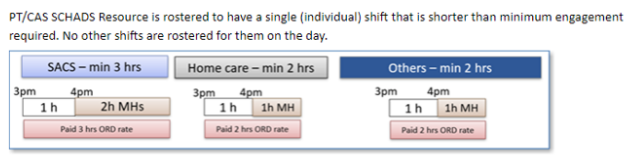
The new rules demand that if you have a worker performing a shift less than the newly mandated requirement – a shift less than 2 hours (or 3 hours for SCS workers not working in disability) – the worker must be paid for the entire minimum hours.
This can have an immediate and significant impact on your worker costs where every shift under 2 hours, that don’t have a shift immediately after, you will be paying your workers double for each of these shifts. This means you are paying workers for hours they are not working.
Further, if you have a worker performing a broken shift – two shifts that have more than the time to travel between them – you must pay the worker a broken shift allowance. This can be on top of minimum hours shift payment as shifts with 2 breaks are not allowed.
How to stop the bleeding
There are some questions you can ask yourself to better understand if and how much these changes might be impacting your business; and, how to manage them moving forward.
Understand the impact.
- Define a timeframe to review – a week, fortnight or month.
- Work out how many shifts you have for casual and part time workers that are less than 2 hours long.
- Calculate the immediate increase in payroll costs for your business.
Follow the rules.
- Identify: Review your current processes so you can identify future occurrences.
- Comply: Make sure minimum and broken shift payments are processed (and compliant with) the Award.
- Be consistent: Be able to demonstrate your compliance with the Award so auditors can see you are following the rules.
How VisiCase solves this challenge
It’s our job to help providers make the complex, simple. Here’s two ways how VisiCase helps you do this.
i. VisiCase includes SCHADS Award Interpretation that now includes all these new rules so your timesheet interface file will ensure your workers are paid correctly with these new rules. An example of the rules in VisiCase is shown below.
ii. VisiCase helps you minimise the impact of this change to your organisation by alerting you to any situation where you are at risk of paying for minimum hours when you are rostering.